
In applications such as highway subgrade construction, mining site preparation, material yard leveling, and access road clearing, the SANY PY190A grader is a commonly used main machine in earthmoving projects due to its stable leveling capabilities. Many maintenance personnel focus on the main scraper, hydraulic pump, and travel transmission components during inspections, often neglecting the drive cylinder for the front bulldozer blade—part number A810201064005. The bulldozer blade cylinder controls the lifting and lowering of the front bulldozer blade; slag removal, material pushing, and auxiliary leveling all rely on the stable output of thrust from this cylinder. The normal operation of the bulldozer blade cylinder directly affects the overall machine’s working efficiency.
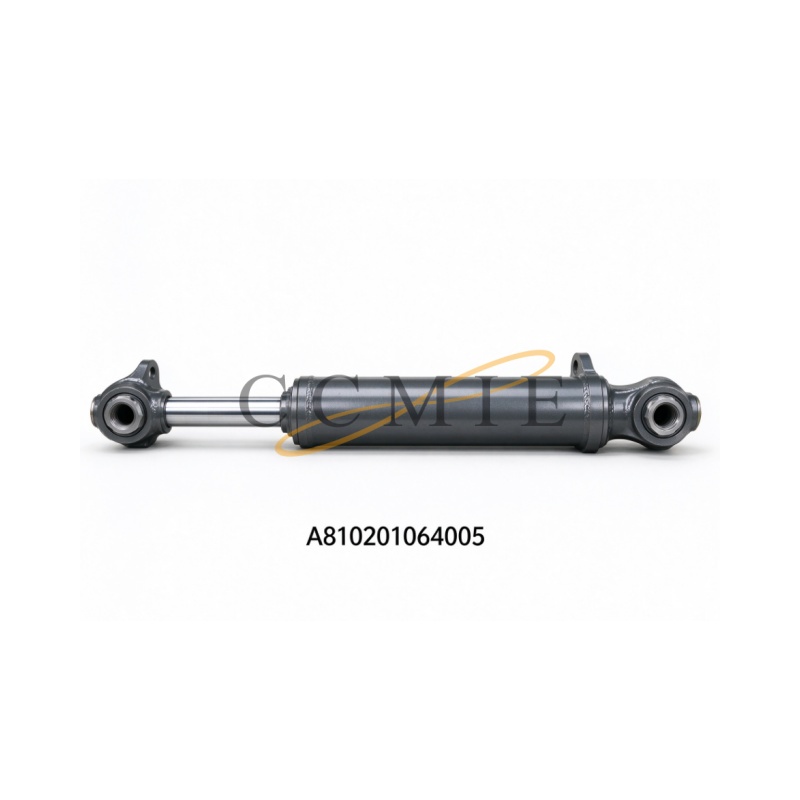
I. What is the A810201064005 bulldozer blade hydraulic cylinder?
The A810201064005 bulldozer blade cylinder is a double-acting, heavy-duty hydraulic cylinder originally supplied to the SANY PY190A grader for the front bulldozer blade. It provides lifting and lowering drive force for the front bulldozer blade. The front bulldozer blade is primarily used for clearing debris from road shoulders, pushing earth, and assisting in flattening soft ground. During operation, the cylinder continuously withstands lateral impacts and heavy load pressure. The A810201064005 bulldozer blade cylinder is designed according to the hydraulic circuit parameters of the SANY PY190A bulldozer. The cylinder barrel, piston rod, guide sleeve, and sealing components are a complete assembly. The mounting hole spacing and oil pipe interface dimensions are perfectly matched to the original vehicle structure. Replacement requires no modification to the bracket or piping, making it highly adaptable and a standard replacement for damaged original cylinders.
II. Product Structural Features and Core Advantages of A810201064005 Bulldozer Blade Hydraulic Cylinder
The A810201064005 bulldozer blade cylinder is optimized for use in dusty, muddy, and splashing construction environments. The piston rod of the A810201064005 bulldozer blade cylinder undergoes a tempering and wear-resistant treatment with chrome plating, making it scratch-resistant and corrosion-resistant, effectively reducing wear under continuous friction from sand and mud. The cylinder barrel of the A810201064005 bulldozer blade cylinder is made of seamless steel tubing, ensuring stable pressure resistance and adapting to the rated working pressure of the grader’s hydraulic system. The seals of the A810201064005 bulldozer blade cylinder are made of oil-resistant and high-temperature-resistant materials, effectively resisting the aging and corrosion of hydraulic oil, thereby effectively reducing the risk of internal and external leakage.
The A810201064005 bulldozer blade cylinder assembly features strict assembly tolerances, ensuring smooth, unhindered operation and uniform bulldozer blade lifting response without sudden changes in speed. Compared to non-standard components, the original factory-spec cylinder’s stress structure matches the bulldozer blade bracket’s stress points, reducing the likelihood of pin tearing or lug deformation. This results in a lower failure rate during long-term continuous operation, making it ideal for scenarios like highway projects and mining sites where continuous operation is required.
III. Common Faults, Causes, and Repair Recommendations for Bulldozer Blade Cylinder A810201064005
Because bulldozer blade cylinders operate under heavy loads and muddy conditions for extended periods, they will gradually wear out over time. Common malfunctions include the following:
a. The bulldozer blades are slow to rise and fall, and the cylinders move sluggishly after the control lever is pulled. In this case, first check the cleanliness of the hydraulic oil and the condition of the filter element. Oil contamination and filter blockage are common causes. After ruling out oil circuit problems, disassemble and check the internal seals. Wear on the seals can cause internal leakage, which can also lead to slow pressure build-up. Generally, replacing the entire set of seals can fix the problem.
b. If the hydraulic cylinder lacks sufficient load capacity and the bulldozer blades sink easily with slight loading, the focus should be on inspecting the internal oil seals and buffer rings of the cylinder. The set pressure of the matching balance valve should also be checked. If only the seals are worn out, replacing the oil seals and buffer rings will restore the pressure. If the valve pressure is off, readjusting it according to the machine’s standard parameters will resolve the issue.
c. Oil leakage from the cylinder guide sleeve and oil port is mostly due to aging of the cylinder seals, damage to the dust seal, or uneven bolt tension during disassembly and assembly. For minor cylinder leakage, stop the machine and replace the corresponding seals. During assembly, tighten the bolts diagonally and evenly to avoid uneven pressure on the sealing surface. If the guide sleeve is worn and the clearance is too large, it is recommended to replace the guide sleeve assembly at the same time.
d. If the bulldozer cylinder is stuck or makes abnormal noises during operation, this is often due to the piston rod being deformed by impact, hard impurities entering the cylinder and scratching the inner wall, or excessive wear of the guide sleeve. For minor sticking, disassemble and clean the cylinder body and replace the dust cover and seals first; however, if the piston rod is bent or there are deep scratches on the inner wall of the cylinder, the repair value is very low, and it is not recommended to continue repairing and use it. It is recommended to replace it with a new cylinder.
If any of the above faults are found, the machine must be stopped and dealt with immediately. Continuing to operate with the faults will easily escalate a simple sealing problem into permanent damage to the cylinder and piston rod, eventually requiring the replacement of the entire cylinder, which will significantly increase maintenance costs.
IV. Daily Maintenance Recommendations for Bulldozer Blade Hydraulic Cylinder A810201064005
Proper routine maintenance is the most effective way to extend the service life of the A810201064005 bulldozer cylinder and reduce sudden failures.
After each day’s bulldozing operation, the mud and gravel adhering to the piston rod surface should be cleaned in a timely manner. If hard particles are attached for a long time, they can easily scratch the chrome-plated protective layer during the expansion and contraction process, thereby damaging the internal sealing components.
During routine inspections, pay close attention to the condition of the dust seal. The dust seal is the first barrier to prevent dust and mud from entering the oil cylinder. If it cracks or is damaged, it needs to be replaced immediately.
Strictly adhere to the equipment maintenance schedule when changing hydraulic oil, return oil filter, and pilot filter. Oil contamination is the leading cause of internal leakage in cylinders and valve core wear. When changing hydraulic oil, ensure the oil type is compatible to avoid mixing different brands, which can cause swelling and aging of seals. When disassembling cylinders to replace oil seals, guide sleeves, and other components, operate in a clean, dust-free environment to prevent impurities from entering the cylinder during assembly. After reassembly, repeatedly raise and lower the bulldozer blades several times under no-load to purge any accumulated air from the cylinder before resuming heavy-duty operations.
When the equipment is stored idle for a long period of time, the bulldozer blades should be completely placed on the ground to allow the piston rod to retract into the cylinder throughout the entire process. This reduces the direct exposure of the chrome-plated rod and provides proper covering and protection to avoid rust problems caused by sun exposure and rain.
Before each heavy-load operation, test the bulldozer blade lifting and lowering under no-load conditions to ensure there is no sluggishness or abnormal noise before proceeding with normal construction.
When problems such as piston rod scoring, cylinder inner wall scratches, and lug deformation occur, and the hydraulic cylinder cannot be restored through repair, it is recommended to directly replace it with a complete bulldozer blade hydraulic cylinder assembly (part number A810201064005). Before purchasing, be sure to verify that the compatible model is a Sany PY190A grader, and confirm the cylinder mounting lug distance, working stroke, oil port position, and interface specifications to avoid purchasing non-standard parts with incompatible parameters. Low-priced non-standard hydraulic cylinders on the market generally have problems such as weak materials, poor sealing quality, and insufficient pressure bearing capacity. After being put into use, they are prone to internal leakage, oil leakage, and insufficient thrust within a short period of time. Repeated repairs will continuously occupy working hours and increase construction and maintenance costs. Especially for overseas engineering projects, the logistics cycle of parts is long, and the downtime costs are even higher. It is recommended to prioritize the selection of replacement assemblies with the same dimensions and pressure parameters as the original vehicle. Assembly does not require modification of brackets and pipelines, and it can be put into use immediately after installation, ensuring the continuous progress of roadbed leveling, site clearing, and other processes, and effectively controlling equipment operation and maintenance costs.
For other parts, please provide us with the part number or visit our related websites:
Click here to visit our spare parts web
Click here to visit our alibaba (There are more kinds of products)
Post time: Oct-21-2026