
In operations such as demolishing old road surfaces, stripping surface layers in mines, and breaking up frozen and hard weathered soil layers, the SANY PY190A grader often relies on the ripper at the rear to break up the hard soil layers first, and then the main scraper completes the subsequent leveling work. The core power for the ripper teeth to successfully cut into the soil layer and stably lift and fall back comes from the hydraulic cylinder of this ripper at the rear.
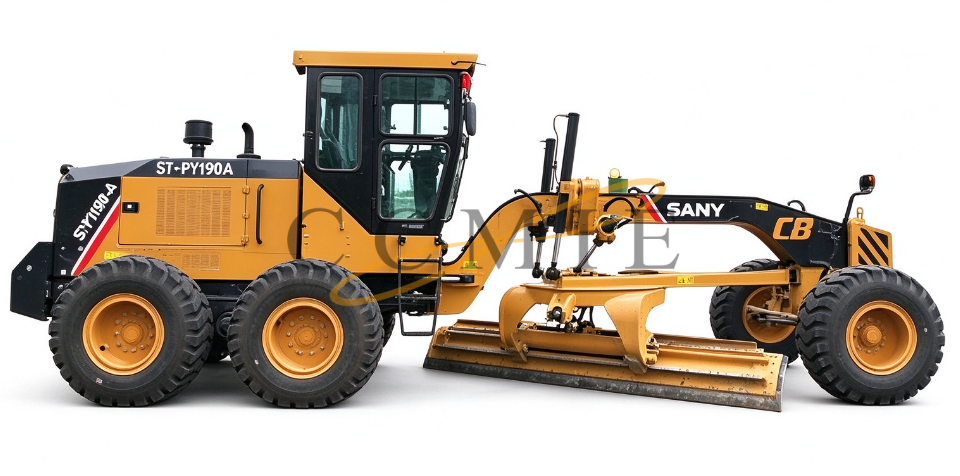
I. What is the A810201064008 ripper cylinder?
The A810201064008 is a dedicated double-acting heavy-duty hydraulic cylinder adapted for the rear ripper of the Sany PY190A grader. One end is hinged to the rear frame of the equipment, and the other end connects to the ripper’s rocker arm assembly. It is used to precisely control the lifting and lowering of the ripper teeth and their penetration depth. Grader ripping operations are unique; when the ripper teeth penetrate, the cylinder needs to continuously output stable thrust to overcome the resistance of hard soil and gravel layers. After breaking the soil, it must also bear the weight of the ripper and the attached debris to smoothly lift it. This A810201064008 ripper cylinder is developed and designed strictly according to the original hydraulic system parameters of the PY190A grader. The cylinder inner diameter, piston rod diameter, mounting lug distance, working stroke, oil port specifications, and installation angle are all completely matched with the original vehicle. In case of cylinder damage, the entire assembly can be replaced directly without modifying the piping, brackets, or pin structure. It is a standard matching hydraulic component for on-site replacement of original parts.
II. Structural Features of the A810201064008 Soil Riser Cylinder
Due to the long-term exposure to impact loads and alternating lateral loads, and the severe dust and gravel contamination in the working environment, the A810201064008 ripper cylinder has been specifically optimized for heavy-duty working conditions in terms of material selection and structural design. The piston rod of the A810201064008 ripper cylinder-Sany Parts undergoes tempering heat treatment and hard chrome plating, providing excellent wear resistance and scratch resistance. The cylinder barrel is made of high-precision seamless hydraulic steel pipe, with the inner wall precision-machined by honing, ensuring strict control of dimensional and positional tolerances and good structural stability under high-pressure conditions. The sealing system of the A810201064008 ripper cylinder uses a temperature-resistant and high-pressure-resistant composite seal combination, which can adapt to fluctuations in hydraulic system oil temperature and effectively suppress internal leakage and external seepage.
The A810201064008 ripper cylinder features wear-resistant bushings at both hinged ends to compensate for angular deviations during ripper entry into the soil, buffer lateral loads, and reduce the additional bending moment borne by the cylinder. The A810201064008 ripper cylinder’s mechanical parameters are matched to the rocker arm mechanism of the Sany PY190A grader’s ripper, and its thrust output characteristics are adapted to the machine’s hydraulic system. This significantly reduces the risk of structural damage such as ear-mount tearing and piston rod bending, making it suitable for long-term continuous heavy-load operations such as roadbed breaking and mining stripping.
III. Common Faults, Troubleshooting Directions, and Maintenance Suggestions for the A810201064008 Tiller Cylinder
After prolonged operation on the construction site, the hydraulic cylinder-Sany Spare Parts of the ripper is prone to several typical malfunctions. When encountering problems, troubleshoot them in order to avoid blind disassembly.
The ripper moves slowly and responds with lag; the cylinder also delays after the control lever is operated. In this situation, first check the cleanliness of the hydraulic oil and whether the return oil filter and pilot filter are clogged. Accumulated impurities in the oil and insufficient oil flow will directly lead to slow pressure build-up. After ruling out problems with the oil circuit and valve assembly, disassemble the cylinder to inspect the internal seals. Worn seals will cause severe internal leakage, resulting in pressure oil loss during circulation within the cylinder and a significant decrease in thrust. Replacing the entire set of compatible seals will usually restore performance.
The ripper sinks automatically after being driven into the soil and the locking mechanism fails, causing the ripping teeth to slide uncontrollably downwards after penetrating the soil. The key to troubleshooting this problem is to check the hydraulic cylinder buffer seal, the check valve, and the pressure setting of the matching balance valve. Aging and failure of the seals, or misalignment of the balance valve’s pressure adjustment, can all cause insufficient pressure holding capacity. Damaged seals need to be replaced, and the valve assembly pressure needs to be readjusted according to the original manufacturer’s technical parameters.
Oil leakage from the outside of the ripper cylinder, and continuous oil leakage from the guide sleeve, oil port flange, and end cover mating surfaces, is mostly caused by aging or damage to the dust seal or main seal, or uneven bolt tightening torque during assembly, causing uneven wear on the seals. In this case, when replacing the seals, the bolts should be tightened diagonally in stages to ensure even force on the sealing surface.
The hydraulic cylinder-Sany Parts Online is stuck and makes abnormal noises during operation. This is usually caused by a bent piston rod due to impact, or by hard particles entering the cylinder wall and causing scoring. Minor scoring or sticking can be temporarily repaired by disassembling, cleaning, and replacing the seals; however, if the piston rod is bent or there are deep scoring marks on the cylinder wall, the repair cost is high and the reliability after repair is poor, so it is recommended to replace the entire hydraulic cylinder assembly.
The ripper is a heavy-duty component. If any abnormality is found, the machine must be stopped and inspected immediately. Continuing to operate with a faulty component will eventually cause the piston rod and cylinder to be scrapped, greatly increasing the maintenance cost.
IV. Routing and Maintenance of A810201064008 Tiller Hydraulic Cylinder
The ripper cylinder-Sany Parts operates in a heavy-duty environment with high dust and lots of gravel for a long time. Maintenance work focuses on pollutant isolation and hydraulic medium control to reduce abnormal wear of sealing components and cylinder moving parts.
After each day’s work is completed, clean the extended part of the piston rod to remove any adhering dirt and hard particles to prevent foreign objects from scratching the chrome-plated working surface during extension and retraction. At the same time, check the front dustproof sealing component. If there are any defects such as damage, aging, or outward turning, it should be replaced immediately to prevent external impurities from entering the cylinder.
Strictly adhere to the original factory maintenance cycle for the SANY PY190A grader, replacing the hydraulic oil, return oil filter, and pilot filter on schedule. Oil contamination is a major cause of internal leakage and cylinder wall scoring. Different grades of hydraulic oil must not be mixed to avoid incompatibility leading to seal swelling and accelerated failure.
Disassembly and repair of the hydraulic cylinder and replacement of seals should be carried out in a clean area to prevent solid impurities from entering the cavity. After assembly, the ripper should be circulated under no-load to purge any trapped air from the cylinder. Only after the operation is stable and without abnormalities can it be put into heavy-duty excavation.
When the equipment is stored for an extended period, lower the ripper to the support position so that the piston rod is fully retracted into the cylinder, avoiding the risk of chrome plating corrosion from exposure. Before resuming work, a no-load test run should be performed to check the cylinder operation, leakage at the sealing surfaces, and any abnormal operating noises. Construction can only commence after the test run has been confirmed to be satisfactory.
When the piston rod is deeply scored, the cylinder inner wall is extensively scratched, or the hinge lug is deformed and cracked, repair is not cost-effective. It is recommended to directly replace it with the A810201064008 ripper cylinder-Sany Spare Parts assembly. When purchasing parts, be sure to confirm that the compatible model is Sany PY190A, and carefully check the mounting lug distance, working stroke, and oil port specifications. Do not choose cheap retrofit parts just because they look similar. Many low-priced aftermarket cylinders have thin walls and poor sealing quality, resulting in pressure loss and oil leakage after a short period of use, requiring repeated disassembly and repair, wasting a lot of labor time. Prioritize the use of matching cylinder assemblies with perfectly matched parameters. After delivery, they can be directly assembled without additional modifications to pipelines and supports, ensuring continuous and stable construction on site and reducing overall operation and maintenance costs.
For other parts, please provide us with the part number or visit our related websites:
Click here to visit our spare parts web
Click here to visit our alibaba (There are more kinds of products)
Post time: Oct-23-2026